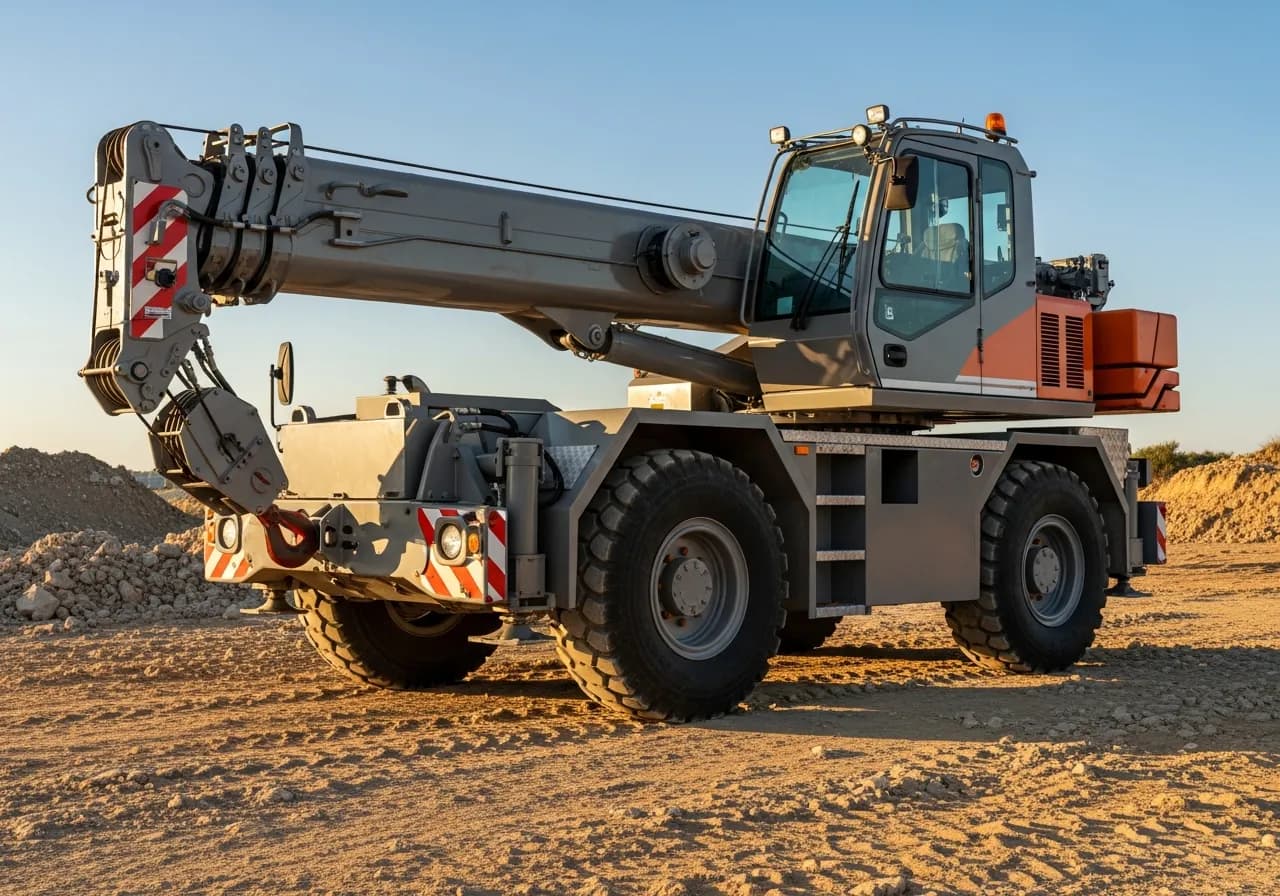
Rough Terrain Crane Rental
Rough Terrain Crane Rental
Rough terrain cranes ride on large rubber tires and four-wheel drive to work off-road on a single engine, pairing a telescoping boom with a compact frame that turns tight inside a job site. They are built for construction, energy and industrial sites where the ground is unpaved and space is limited but a mobile pick is still needed. Kranes arranges rough terrain crane rental, operated or bare, matched to your load chart and access.
Best for Unpaved, tight construction sites
Key specifications
- Four-wheel drive, off-road tires
- Compact, tight-turning frame
- Telescoping boom
- Operated or bare rental
- Load-chart matched
About Rough Terrain Crane Rental
Key Takeaways
- ✓Rough Terrain Crane Rental pricing: By quote
- ✓Key features: Four-wheel drive, off-road tires, Compact, tight-turning frame, Telescoping boom
A rough terrain crane is a single-engine mobile crane built to work off-road. Large flotation tires and full-time four-wheel drive carry it across mud, gravel and graded fill, while four-wheel steering and a short, stiff frame let it turn tight inside a congested site. A telescopic boom gives quick setup and useful height and radius, and the compact deck keeps the machine within the footprint a job site can spare — capability a road-going crane cannot match on raw ground. That makes rough terrain crane rental the standard pick for construction, energy and industrial sites before the ground is paved.
Rough Terrain Crane Rental — Configurations
It sets steel and precast, places mechanical and process equipment, supports civil and foundation work and handles the day-to-day picks a project runs on. Where a job needs more road mobility between locations, an all terrain crane covers the gap; Kranes helps choose between the two so the machine fits both the lift and how far it has to travel on the job. The right rough terrain crane comes off the load chart: the heaviest pick, the radius, the lift height and the ground it stands on. Send those plus the site access and Kranes returns a quote with the capacity class, the counterweight and the rigging, operated or bare.
Applications
Rough terrain crane rental runs by the day, the week or the project, with transport coordinated so the machine — which is not built for highway travel — arrives ready to work. On unfinished ground the safety margin matters most, so every machine is inspected and certified before it ships. Kranes supplies rough terrain cranes documented to OSHA and ASME B30. 5 standards, with NCCCO-certified operators available and a parts and service network that keeps the crane running through the rental.
Service & support
Tell us the lift, the site and the dates, and we send a quote for the right rough terrain crane to keep the job moving.
“Ensure that no part of the equipment, load line, or load (including rigging and lifting accessories), gets closer than 20 feet to the power line by implementing the measures specified in paragraph (b) of this section.”
At a glance
| Specification | Details |
|---|---|
| Product | Rough Terrain Crane Rental |
| Price range | By quote |
| Best for | Unpaved, tight construction sites |
| Makes covered | All major makes |
| Operation | Operated or bare |
| Warranty | By quote |
| Compliance | OSHA / ASME B30 |
| Coverage | Nationwide (US) |
Why choose Rough Terrain Crane Rental?
What this equipment is built to do.
Rough Terrain Crane Rental across the United States
Kranes supplies rough terrain crane rental directly in major cities across the United States.
Questions about Rough Terrain Crane Rental
How much does crane rental cost?
There's no honest flat rate — crane rental (or crane hire) is priced per job. The main drivers are the crane class and capacity, how long you need it (hourly, daily, weekly or by project), whether you need a certified operator, the rigging required, and site access. A small boom-truck pick costs a fraction of a multi-day mobile or tower-crane job. Rather than quote a misleading average, Kranes prices your exact lift: send the load, the radius, the lift height and the timing, and we return a clear, itemized quote within 24 hours so you can budget with confidence. Longer commitments usually lower the effective rate.
What is the 3-3-3 rule for cranes?
The 3-3-3 rule is a quick safety habit some operators use: take three seconds to start a movement smoothly, hold steady for three seconds, and take three seconds to stop — keeping loads from swinging through sudden acceleration or braking. It's a rule of thumb, not a regulation, and it never replaces a proper lift plan, load chart and the operator's judgment. On any Kranes lift, NCCCO-certified operators follow the manufacturer's load chart and OSHA 1926 Subpart CC practice, with the rigging and ground conditions verified before the load leaves the ground. If a load starts to swing, the operator stops and lets it settle before moving again.
What does "crane services" mean?
"Crane services" covers everything around getting a load lifted safely beyond just the machine: supplying the crane (sale or rental), providing certified operators, planning and engineering the lift, rigging, and the ongoing maintenance, inspection, certification and parts that keep a crane compliant. As the nationwide supplier, Kranes covers all of it — sales, rental, service and parts — from one request. You describe the job; we provide the crane and the certified support to complete it, then keep it running afterward. That includes inspection records, certified operators and a written quote that spells out every part of the scope before the crane mobilizes.
What is the 10-foot rule for cranes?
The "10-foot rule" is the common name for keeping cranes, loads and rigging a minimum distance from overhead power lines. In general industry, OSHA 29 CFR 1910.333 sets 10 feet for lines up to 50 kV, plus 4 inches for every 10 kV above that. For cranes used in construction, OSHA 29 CFR 1926.1408 is stricter: if any part of the crane, load line or load could come within 20 feet of a power line up to 350 kV, the employer must de-energize and ground the line, keep a 20-foot clearance, or use the voltage-based clearance table. Every Kranes lift plan checks for overhead lines, and certified operators keep the required clearance throughout the lift.
Get a quote for Rough Terrain Crane Rental?
Tell us the job and we send a quote within 24 hours.